
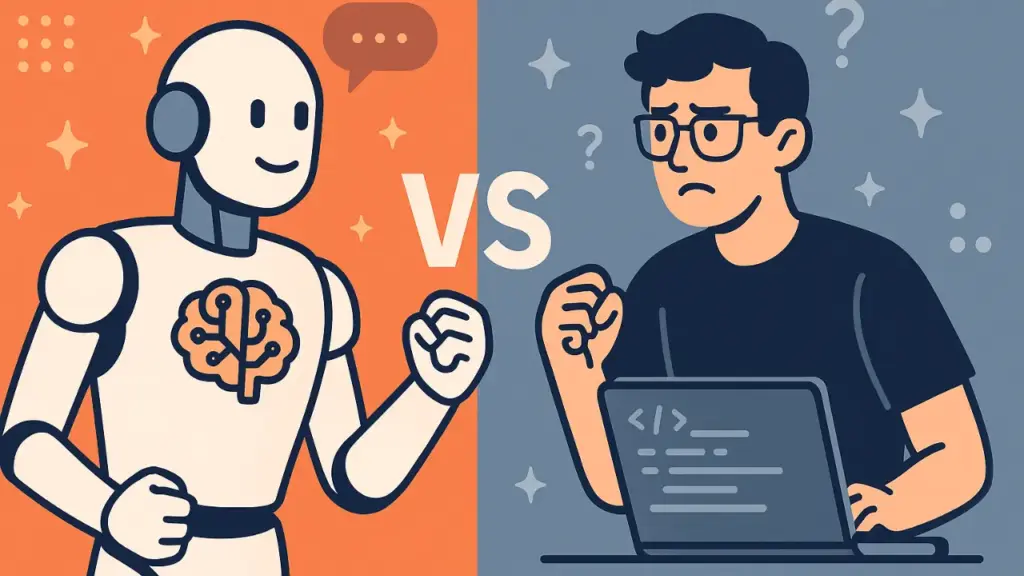
Artificial Intelligence is transforming nearly every industry, and software development is no exception. With the rise of AI-powered coding tools, automated testing systems, and intelligent development assistants, many people are asking an important question: Will AI replace human developers?
Tools such as GitHub Copilot and AI-driven development platforms have demonstrated that machines can generate code, suggest optimizations, and even assist with debugging. However, software development is far more than writing lines of code. It involves creativity, architecture design, problem-solving, and collaboration.
In this article, we explore the relationship between AI and human developers, examine the strengths and limitations of both, and discuss what the future of software development might look like.
Table of Contents
The Rise of AI in Programming
Artificial Intelligence has made significant progress in assisting developers with everyday tasks. AI systems trained on massive datasets of code can analyze patterns and generate relevant suggestions in real time.
For example, tools like GitHub Copilot use machine learning models to provide context-aware code completions. These systems are capable of generating functions, recommending algorithms, and even creating documentation automatically.
Research from McKinsey & Company suggests that generative AI could significantly increase developer productivity by automating repetitive coding tasks.
This rapid progress has sparked debates about whether AI could eventually replace human programmers.
What AI Does Better Than Humans
AI excels in certain areas of software development where speed and pattern recognition are essential.
Automating Repetitive Tasks
Developers often spend time writing boilerplate code, configuring systems, or generating documentation. AI tools can automate these repetitive activities quickly and accurately.
Code Suggestions and Autocompletion
AI-powered IDE assistants can suggest entire code blocks based on a few lines of input. This speeds up development and reduces the need for manual coding.
Large-Scale Code Analysis
AI systems can scan large codebases to detect bugs, vulnerabilities, or performance issues. Tools like SonarQube analyze source code automatically to identify security and maintainability problems.
Test Generation
AI can generate automated tests and detect edge cases that developers might overlook. Frameworks like Selenium are increasingly integrated with AI-driven testing capabilities.
These strengths make AI an excellent productivity tool for development teams.
What Human Developers Do Better
Despite AI’s impressive capabilities, human developers still play an essential role in software engineering.
Creative Problem Solving
Software development often requires creative thinking to design innovative solutions. AI can analyze patterns but struggles with novel problems that require intuition and abstract reasoning.
System Architecture and Design
Designing scalable software architectures involves understanding business requirements, trade-offs, and long-term goals. Human developers excel at making strategic decisions about system structure and technology choices.
Understanding User Needs
Successful software must address real-world user problems. Developers interact with stakeholders, interpret feedback, and translate business needs into technical solutions.
Ethical and Strategic Decision Making
AI lacks the ability to understand ethical implications, societal impact, and organizational goals. Humans must guide the development process to ensure responsible technology use.
These human-centered skills make developers indispensable in the software lifecycle.
AI as a Developer’s Assistant
Rather than replacing programmers, AI is more likely to function as an intelligent assistant that enhances developer productivity.
AI tools help developers:
- Write code faster
- Identify bugs earlier
- Automate testing and documentation
- Improve code quality
- Focus on high-level design tasks
For example, cloud platforms like Amazon Web Services use AI-powered analytics to help developers optimize infrastructure and application performance.
By handling repetitive tasks, AI allows developers to focus on innovation and strategic work.
The Changing Role of Software Developers
As AI becomes more integrated into development workflows, the role of developers will evolve.
Future developers will need stronger skills in areas such as:
- System architecture and design
- AI tool integration
- DevOps and automation
- Cybersecurity and secure coding
- Data engineering and analytics
According to insights from the Stanford Human-Centered AI Institute, the most successful engineers will be those who can effectively collaborate with AI systems.
Developers will become technology strategists rather than simply code writers.
Potential Risks of AI in Development
Although AI offers many benefits, it also introduces challenges that organizations must address.
Security Vulnerabilities
AI-generated code may contain vulnerabilities if not carefully reviewed. The OWASP Foundation emphasizes the importance of secure coding practices even when using automated tools.
Over-Reliance on Automation
Developers who rely too heavily on AI suggestions may lose a deep understanding of programming concepts.
Intellectual Property Concerns
There are ongoing debates about the ownership of AI-generated code and the datasets used to train AI models.
Organizations must establish clear policies for responsible AI usage in software development.
The Future: Collaboration Between Humans and AI
The most realistic future is one where AI and human developers work together. AI will automate routine tasks, while humans will guide the design, strategy, and ethical direction of technology.
Future development environments may include:
- AI-powered coding assistants integrated into IDEs
- Automated debugging and testing systems
- Intelligent DevOps pipelines
- Natural language programming interfaces
These innovations will transform how software is built but will still require human expertise to guide and refine the process.
Conclusion
AI is revolutionizing software development, but it is unlikely to replace human developers. Instead, it will serve as a powerful tool that enhances productivity and improves efficiency.
While AI excels at automation, pattern recognition, and large-scale analysis, human developers bring creativity, strategic thinking, and real-world understanding to the development process.
The future of programming will be defined by collaboration between humans and intelligent machines. Developers who embrace AI tools and adapt their skills will be well-positioned to thrive in this evolving technological landscape.
Also Check OWASP Top 10 for Developers – Powerful Guide 2026